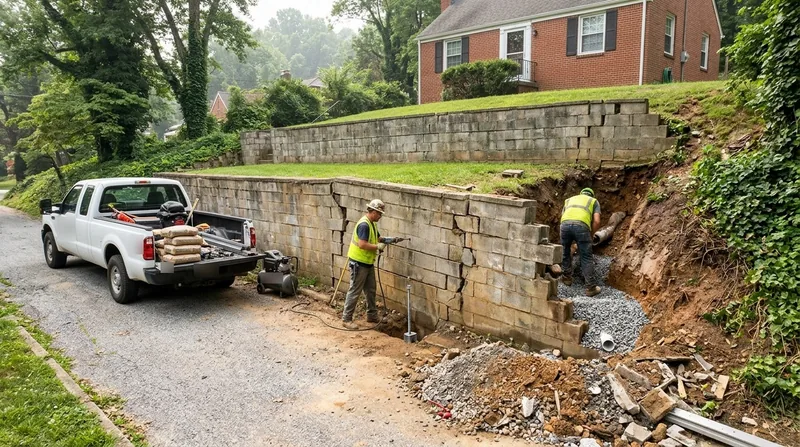




Baltimore is a city built on grades. From the filled harbor ground of Canton and Fells Point up through the stream valleys of the Jones Falls, Gwynns Falls and Herring Run, almost every yard sits above or below something. When a wall starts to lean, bulge or cave in, we respond fast with Leaning & Collapsed Wall Repair in Baltimore, stabilizing the structure before the slope above it moves with it. Clay-rich soils, summer cloudbursts and freeze-thaw cycles push poured concrete, CMU and old fieldstone walls out of line year after year. We read the failure, correct the drainage that caused it and rebuild what can't be saved. If you're still deciding between fixing and starting over, start with our retaining wall repair page to see how we triage a failing wall.
Why Baltimore Walls Fail: Clay Soil, Steep Grades and Harbor-Fill Ground
Baltimore's residential stock puts enormous load on retaining walls. Roland Park, Guilford and Mount Washington sit on hilly, wooded lots where early-1900s walls hold back saturated clay. Federal Hill, Canton and Hampden pack brick rowhouses tight against small rear yards with nowhere for water to go. Across Baltimore County, 1940s-60s brick Capes and ranches sit behind driveway walls that have been quietly pushing out for decades.
- Hydrostatic pressure builds when clay soil and blocked weep holes trap stormwater behind the wall.
- Freeze-thaw cycles in January and February open joints and lever block faces out of line.
- Summer cloudbursts and tropical storm rain saturate slopes fast and blow out underdrained walls.
- Rotting timber and railroad tie walls lose their structural capacity and slump without warning.
- Tree roots and mature canopy on wooded lots heave footings and crack poured concrete.
The pattern repeats across the city, and it almost always traces back to water that was never given a path out.
Key info: A CMU driveway wall in Parkville that bulges after a July downpour is usually a drainage failure, not a block failure. Fix the water first and the wall often stays put. Skip it and you rebuild the same wall twice.
For permit thresholds and engineered drawing requirements, verify with the Maryland Department of Housing and Community Development and your local building department before any rebuild starts.
How We Stabilize and Rebuild a Failing Wall in Baltimore
We don't guess at a leaning wall. We dig, we probe and we find out what the soil and the footing are actually doing before we quote a fix. Then we sequence the work so the slope above stays put while we correct the wall below.
- We inspect the wall face, footing, weep holes and soil behind it to identify the failure mode.
- We relieve hydrostatic pressure by opening drainage and correcting grading behind the wall.
- We install tieback anchors or helical piers to pull a leaning wall back to plumb where the structure allows.
- We rebuild failed sections with proper base, batter and drainage stone when anchoring won't hold.
- We restore the surface and backfill in lifts so the repaired wall carries load evenly.
Every repair ends with a drainage path that actually works, because that is what keeps the wall standing.
Key info: A collapsed fieldstone wall above the Gwynns Falls in Catonsville needed a partial rebuild with anchored sections and a new French drain. The homeowner caught the lean in April, before the summer storms finished the job.
If the wall sits on a failing slope rather than failing on its own, pair the repair with our slope stabilization and erosion control work so the ground above stays where it belongs.
Repair Approaches We Use on Baltimore Walls
| Approach | Description | Best for |
|---|---|---|
| Tieback anchoring | Steel anchors driven into stable soil pull a leaning wall back toward plumb. | Bulging CMU and concrete walls with intact faces |
| Drainage correction | We open weep holes, add drainage stone and regrade the soil behind the wall. | Walls pushed out by hydrostatic pressure |
| Partial rebuild | We remove and reset failed sections on a proper base with new drainage. | Collapsed or cracked sections of longer walls |
| Full rebuild | We tear out and reconstruct the wall when the footing or structure is past saving. | Rotting timber walls and failing fieldstone |
Leaning & Collapsed Wall Repair Cost in Baltimore: What to Expect
Most leaning and collapsed wall repairs in Baltimore start at $2,500, and that figure covers a real scope: inspection, drainage correction and a partial reset or anchored section. The number climbs with wall length, height, access and how much of the structure is actually gone. A tight rear yard in Canton or Hampden costs more to work in than an open lot in Owings Mills.
- Wall length and height drive material and labor more than any other factor.
- Access matters in rowhouse blocks where equipment can't reach the wall face.
- Proximity to a driveway, structure or property line adds engineering and permitting time.
- Emergency stabilization after a collapse carries a premium over a planned repair.
Get two or three estimates and compare scope, not just the bottom line, because a cheap quote that skips drainage will cost you the wall again. Our full pricing overview breaks down how each factor moves the number.
Hiring a Retaining Wall Contractor Near Me in Baltimore: What to Check
Wall repair is not a job for a general handyman with a skid steer. A leaning wall is holding back a slope, and a bad repair can turn a lean into a collapse onto a driveway or a neighbor's yard. Ask hard questions before you sign anything.
- Confirm the contractor is fully insured and ask for the certificate before work starts.
- Get multiple written estimates that spell out drainage work, not just block replacement.
- Ask for references from jobs in Baltimore County and check them.
- Understand permit requirements for walls over roughly 4 feet or walls supporting a surcharge.
- Check HOA rules in Columbia or Owings Mills before you change the wall's look.
When you're ready to talk through a failing wall, contact us for a free estimate and we'll tell you straight whether it can be saved.
Leaning & Collapsed Wall Repair in Baltimore: Pricing Guide
| Service | Price | Details |
|---|---|---|
| Partial section rebuild | Starting at $2,500 | Includes inspection, drainage correction and resetting failed sections on a proper base |
| Tieback anchoring | Starting at $3,800 | Anchors pull a bulging wall back to plumb where the face is still intact |
| Full wall rebuild | On estimate | We need an on-site look at footing, height, access and soil before quoting |
| Emergency stabilization | On estimate | After a collapse we assess load and slope risk before any number is given |
| Travel | Included | In Baltimore and surrounding areas, no separate call-out or mileage fee |
| Estimate | Free | Response within 24h at (443) 806-9687, no obligation to book |
Indicative pricing, the exact cost depends on square footage, finish, and site access. Free personalized estimate within 24h at (443) 806-9687.


