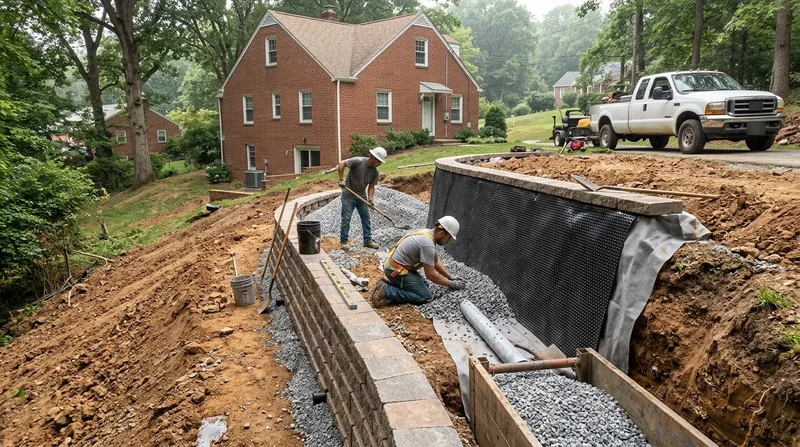




If you own a home in Baltimore, from the brick rowhouses of Federal Hill and Canton to the wooded hillside properties in Roland Park and Mount Washington, your retaining wall is under constant attack from water. Proper Retaining Wall Drainage in Baltimore is the single most important factor in whether that wall stands for decades or leans out within a few seasons. Our city's clay-rich soils, steep stream valleys along the Jones Falls and Gwynns Falls, and intense summer cloudbursts create hydrostatic pressure that pushes walls out of line. We install French drains, weep holes, gravel backfill, and waterproofing systems that relieve that pressure before it causes failure. Whether your wall is poured concrete, segmental block, or old fieldstone, the drainage behind it matters more than the face you see. Call our retaining wall repair team at (443) 806-9687 to assess your drainage situation.
Why Drainage Makes or Breaks Retaining Walls Across Baltimore
Baltimore's soil profile is the problem. Much of the city sits on clay-heavy fill and residual soils that absorb water slowly and hold it against your wall. When a summer thunderstorm dumps two inches in an hour, that water has nowhere to go except into the backfill. Add winter freeze-thaw cycles that expand saturated soil, and you get the leaning, cracking walls we see every week in Hampden, Parkville, and Dundalk. The failure mode that dominates here is hydrostatic pressure buildup in clay soils, not coastal erosion or frost heave alone.
- Clay soils trap water against the wall face and prevent natural drainage.
- Summer cloudbursts and tropical storm remnants overwhelm undersized or missing drains.
- Freeze-thaw cycles push saturated backfill outward, cracking mortar and shifting block.
- Downspouts and gutter runoff concentrated near walls accelerate saturation.
- Tree roots from mature oaks and maples in Roland Park and Guilford invade drain lines.
Every one of these factors points to the same fix: manage the water before it reaches the wall.
Key info: A segmental block wall in Catonsville that we inspected had no weep holes and no gravel backfill. After three wet seasons, the wall had rotated four inches at the top. Weep holes alone would have prevented most of that movement.
For official guidance on when retaining wall permits and inspections apply in Baltimore, check the Baltimore City Department of Housing and Community Development. Thresholds vary by jurisdiction and wall height, and you should always verify with the local building department before starting work.
How We Install Retaining Wall Drainage in Baltimore, Step by Step
We do not guess at drainage. Every job starts with a site assessment that looks at soil type, slope, water sources, and the wall's current condition. From there we design a system that moves water away from the wall and out to a safe discharge point. Here is how a typical drainage retrofit or new installation goes on a Baltimore County property.
- We excavate behind the wall to expose the backfill and inspect for existing drain lines or failure points.
- We install a perforated French drain pipe at the footing level, wrapped in filter fabric and set in washed gravel.
- We add weep holes through the wall face at regular intervals to release any water that reaches the wall.
- We backfill with clean gravel and filter fabric to keep clay fines from clogging the drain.
- We waterproof the wall face where needed and tie downspouts into the drainage system.
- We discharge water to daylight, a storm drain, or a dry well, never onto a neighbor's property.
Each step matters. Skip the filter fabric and the drain clogs within a year. Skip the gravel and the pipe sits in mud.
Key info: On a hillside lot in Mount Washington, we tied a French drain behind a 6-foot segmental wall into a dry well 20 feet downhill. The homeowner had been pumping water out of their basement every spring. That stopped after the drainage work.
If your wall is already showing movement, see our leaning and collapsed wall repair service before drainage work begins. Structural repair comes first.
Drainage Approaches We Use on Baltimore Walls
Not every wall needs the same drainage solution. A poured concrete driveway wall in Glen Burnie has different requirements than a dry-stacked fieldstone wall in Ellicott City. We match the approach to the wall type, soil conditions, and water volume. Here is a comparison of the methods we use most often.
| Approach | Description | Best for |
|---|---|---|
| French drain behind wall | Perforated pipe in washed gravel at footing level, wrapped in filter fabric | Most walls with clay backfill and high water tables |
| Weep holes | Openings through the wall face to release trapped water | Concrete and CMU walls with minimal existing drainage |
| Gravel backfill with fabric | Clean stone wrapped in filter fabric to prevent clogging | New installations and full drainage retrofits |
| Surface waterproofing | Membrane or coating on the wall face to block moisture | Poured concrete walls in wet, shaded sites |
| Dry well or discharge line | Directs collected water to a safe release point away from the wall | Hillside properties in Roland Park and Mount Washington |
The right combination depends on your wall and your lot. We tell you what you need and what you do not.
Retaining Wall Drainage Cost in Baltimore: What to Expect
Drainage work starts at From $2,500 for a basic French drain retrofit on a residential wall. That figure covers excavation, pipe, gravel, filter fabric, and discharge for a typical 20 to 30 foot wall. Most Baltimore homeowners spend between $2,500 and $6,000 depending on wall length, access, and how much soil has to be moved. A full drainage system for a tall tiered wall in Columbia or a long driveway wall in Dundalk can run higher.
Several factors move the price. Wall length and height drive material quantities. Access matters: a wall behind a rowhouse in Fells Point with no alley access takes more labor than a suburban lot in Owings Mills. Soil type affects excavation difficulty. If the wall is already failing, structural repair adds cost before drainage can be addressed. And if you need a dry well or a long discharge line to daylight, that adds to the total.
We recommend getting two or three estimates for any drainage project. Prices vary, and so does the quality of the diagnosis. A contractor who does not inspect the soil and water sources is guessing. For a detailed breakdown of what we charge, see our full pricing page.
Retaining Wall Drainage Near Me: What Baltimore Homeowners Should Check Before Hiring
When you search for retaining wall drainage near me in Baltimore, you will get a long list of contractors. Here is how to separate the ones who know drainage from the ones who will sell you a drain pipe and disappear. The questions below are the same ones we would ask if we were hiring someone for our own homes.
- Confirm the contractor is fully insured in Maryland and ask for a certificate of insurance.
- Get at least three written estimates that specify materials, pipe size, and discharge location.
- Ask for references from jobs in Baltimore or Baltimore County and call them.
- Ask whether a permit is required for your wall height and whether the contractor will pull it.
- Check for HOA requirements if you live in a community in Owings Mills or Glen Burnie.
A contractor who cannot answer these questions clearly is not the right one for your wall.
Ready to get a real assessment? Contact us for a free estimate at (443) 806-9687. We serve homeowners across Baltimore and the surrounding communities, and we will tell you exactly what your wall needs.
Retaining Wall Drainage in Baltimore: Pricing Guide
| Service | Price | Details |
|---|---|---|
| French drain retrofit | Starting at $2,500 | Includes excavation, perforated pipe, washed gravel, filter fabric, and discharge for a typical residential wall |
| Weep hole installation | Starting at $650 | Drilled weep holes with gravel pockets and fabric, priced by wall length and access difficulty |
| Full drainage system with dry well | Starting at $4,800 | French drain, gravel backfill, waterproofing, and dry well or discharge line to daylight |
| Complex or large-scale job | On estimate | Tiered walls, long driveway walls, and hillside sites need an on-site inspection before pricing |
| Travel | Included | in Baltimore and surrounding areas, no separate call-out or mileage fee |
| Estimate | Free | Response within 24h at (443) 806-9687, no obligation to book |
Indicative pricing, the exact cost depends on square footage, finish, and site access. Free personalized estimate within 24h at (443) 806-9687.


