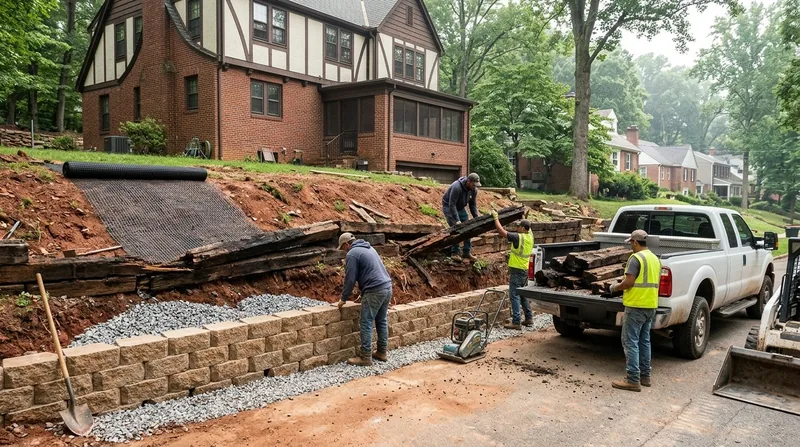




Baltimore's terrain climbs from the filled harbor ground in Federal Hill and Canton up through the steep stream valleys of the Jones Falls, Gwynns Falls and Herring Run. That grade change is why so many 1970s and 80s properties in Roland Park, Guilford, Mount Washington and the Baltimore County Cape Cod neighborhoods got railroad tie walls in the first place. Those creosote-soaked ties are now forty to fifty years old, and the clay-rich soil, summer cloudbursts and winter freeze-thaw cycles have pushed most of them out of line. Railroad Tie Wall Replacement in Baltimore means pulling the rotting timber, hauling the treated wood, fixing the drainage that failed, and rebuilding in segmental block, concrete or natural stone. We handle the demolition, the gravel backfill and the rebuild on hilly lots across the city and county. If your wall is still standing but leaning, start with leaning and collapsed wall repair before the whole structure goes.
Why Railroad Tie Walls Fail in Baltimore's Clay Soil and Freeze-Thaw Winters
Railroad ties were sold as a cheap, fast retaining solution in the 1970s and 80s, and on Baltimore's hilly wooded lots they worked for a while. The problem is that creosote-treated timber rots from the inside out, especially when the backfill stays wet. Baltimore's clay-rich soils hold water against the wood, and the freeze-thaw cycle we get from December through March cracks and heaves the ties a little more each year. By the time a wall in Catonsville or Parkville is visibly leaning, the bottom courses are usually gone.
- Creosote-treated ties decay and lose structural strength after 25 to 35 years in wet clay backfill.
- Original walls were often built without gravel backfill or a drain pipe, so hydrostatic pressure pushes them out.
- Freeze-thaw movement in Baltimore County opens gaps and shears the tie-to-tie connections.
- Rotting ties attract termites and carpenter ants, which then move toward nearby structures.
- Many older walls sit above the 4-foot threshold that triggers a permit and engineered review.
Replacing the wall is almost always cheaper than repeated patching once the lower courses are soft.
Key info: A 1980s tie wall on a sloped Guilford lot we replaced had no drainage stone behind it at all. The ties were saturated, the wall had pushed 6 inches out of line, and the fix required a full tear-out plus a new perforated drain and gravel envelope before any new block went in.
For official guidance on when a retaining wall needs a permit, check the Maryland Department of Housing and Community Development and your local Baltimore City or county building department, since thresholds vary by jurisdiction.
How We Replace a Railroad Tie Wall in Baltimore, Step by Step
Every replacement starts with a site visit to measure the wall height, check the soil and grade, and figure out how equipment gets to the back yard. On rowhouse lots in Canton and Fells Point, that often means hand-carrying material through a gangway. On the larger wooded lots in Mount Washington and Owings Mills, we can usually bring a small machine in. The sequence below is what a typical tie wall replacement looks like from demolition to final compaction.
- We mark utilities and confirm the property line and any setback rules before any digging starts.
- We demolish the old ties, cut them to manageable lengths and haul the treated wood to an approved disposal facility.
- We excavate to the footing depth and shape a compacted gravel base that matches the new wall system.
- We install a perforated drain pipe, filter fabric and clean gravel backfill so water never sits against the new wall.
- We build the new wall in segmental block, poured concrete or natural stone, compacting in lifts as we go.
- We backfill, compact, and restore the grade and any plantings disturbed during the work.
The drainage step is the one most homeowners never see, and it is the reason a replacement lasts decades instead of years.
Key info: A tie wall replacement in Dundalk we finished last spring sat on flat, sandy fill near the harbor. The old ties had rotted at the base but the wall itself was only 3 feet tall, so no permit was needed. The same wall height in Ellicott City, on a steeper lot, would have triggered an engineered review.
If the wall is tied into a driveway or a structure, we coordinate with retaining wall drainage and any needed slope work before the rebuild.
Replacement Options: Which Wall System Fits Your Baltimore Lot
Once the old ties are out, you have three realistic choices for the rebuild. The right one depends on wall height, how much load it carries, access for materials, and how the finished wall needs to look next to your house. The table below compares the approaches we install most often on Baltimore tie wall replacements.
| Approach | Description | Best for |
|---|---|---|
| Segmental block | Interlocking concrete block with gravel core and drain, built in lifts. | Most residential tie wall replacements up to 6 feet, including curved walls. |
| Poured concrete | Reinforced concrete wall formed and poured on site with a footing. | Tall walls, driveway surcharges and straight runs where strength matters most. |
| Natural stone or boulder | Fieldstone or boulder wall laid with proper batter and drainage. | Wooded lots in Roland Park and Mount Washington where a natural look fits. |
| Timber (new pressure-treated) | Modern pressure-treated timber built with gravel backfill and deadmen. | Low garden walls under 3 feet where budget and look favor timber. |
We match the system to the lot, not the other way around, and we tell you when a cheaper option will not hold.
Railroad Tie Wall Replacement Cost in Baltimore: What to Expect
Most tie wall replacements in Baltimore start around $35 per square foot of wall face, and that figure moves with height, access, demolition volume and the finish you choose. A short 3-foot garden wall on a Catonsville lot is a very different job from a 6-foot wall holding up a driveway in Pikesville. The old ties are heavy, treated and costly to dispose of, so demolition and haul-away are a real line item, not a rounding error. Getting two or three written estimates is the smartest thing you can do before signing anything.
- Wall height and total square footage drive most of the price, since taller walls need bigger footings and more material.
- Access matters: a back yard reached only through a rowhouse gangway costs more in labor than a lot a machine can reach.
- Creosote tie disposal fees vary and add to the demolition cost on every job.
- Drainage corrections, footing repairs and soil replacement add scope when the old wall failed because of water.
- Finish choice (block, concrete, natural stone) changes material cost by a wide margin.
Ask each contractor what is included in the number, especially disposal and drainage, so you are comparing the same scope.
Key info: A 40-foot, 4-foot-tall tie wall replacement in Glen Burnie typically lands in the low five figures once demolition, disposal and new block are included. The same wall in natural stone runs higher, and a 3-foot garden wall can come in well under that. The full breakdown is on our pricing page.
Choosing a Railroad Tie Wall Replacement Contractor Near Me in Baltimore
Hiring the right contractor matters more on a retaining wall than on almost any other exterior project, because a bad rebuild fails quietly and then all at once. Start with fully insured status, and ask for the certificate, not just a verbal yes. Get at least two or three written estimates with the same scope so you can compare apples to apples. Check references from jobs in Baltimore County and the city, and ask specifically about walls on sloped lots. Finally, confirm who pulls the permit if your wall is tall or holds up a driveway, because the building department will require it.
If your wall sits near a property line, in a historic district, or under HOA rules, sort that out before demolition day. A quick call to your local building department confirms the permit threshold, and your HOA can tell you about approved materials and colors. We are happy to walk through those details with you before you commit. Reach out through our contact page to schedule a free on-site estimate.
Railroad Tie Wall Replacement in Baltimore: Pricing Guide
| Service | Price | Details |
|---|---|---|
| Railroad tie wall replacement, standard access | Starting at $35/sq ft | Includes tie demolition, haul-away, gravel backfill, drain and segmental block rebuild on an accessible lot. |
| Railroad tie wall replacement, limited access | Starting at $45/sq ft | Hand-carry through rowhouse gangways or tight back yards adds labor and disposal time to the base rate. |
| Tall or surcharge wall (over 4 ft or driveway) | On estimate | Engineered design, larger footing and permit review are needed before a firm number can be given. |
| Natural stone or boulder finish | Starting at $55/sq ft | Material cost and hand-setting time push stone above block on the same wall footprint. |
| Travel | Included | In Baltimore and surrounding areas, no separate call-out or mileage fee. |
| Estimate | Free | Response within 24h at (443) 806-9687, no obligation to book. |
Indicative pricing, the exact cost depends on square footage, finish, and site access. Free personalized estimate within 24h at (443) 806-9687.


