Why Baltimore's Soil and Slopes Demand the Right Wall Material
If you live in Baltimore, you already know that the ground here is not always friendly to construction. Much of the region sits on heavy clay that swells when wet and shrinks when dry, and that seasonal movement can quietly undermine a wall that was built without the right material and drainage plan. Add in the rocky outcroppings found in parts of the city and surrounding counties, plus the steep lots common in neighborhoods built into hillsides, and you have a set of conditions that reward careful material selection.
Choosing the best material is not about picking whatever looks nice in a catalog. It is about matching the wall's strength, drainage behavior, and flexibility to the soil and grade on your property. A material that performs beautifully on a flat sandy lot may struggle on a Baltimore clay slope, and a wall that is overbuilt for a gentle grade can waste money. This guide walks through the four materials homeowners ask about most: concrete, block, boulder, and segmental retaining walls, so you can have a more informed conversation before any work begins.
Concrete Retaining Walls: Maximum Strength for Challenging Grades
Concrete Retaining Walls are the heavy hitters of the retaining world. Poured concrete can be engineered to hold back significant loads, which makes it a strong candidate for tall walls, steep lots, and situations where the soil is pushing hard. On a Baltimore property with a deep grade change, a properly reinforced concrete wall gives you confidence that the structure will stay put for decades. It also offers a clean, modern look and can be finished with textures or facings if you want something softer than raw gray concrete.
The tradeoff is cost and rigidity. Poured concrete typically requires deeper footings, more extensive excavation, and professional engineering, which pushes the project budget higher than other options. Because it is rigid, it also demands excellent drainage behind the wall; trapped water and clay pressure are the enemies of any retaining structure. For homeowners facing a serious slope or a wall that must protect a driveway or foundation, concrete is often worth the investment. For shorter decorative walls, it is usually more than you need.
Block and Segmental Retaining Walls: The Versatile Middle Ground
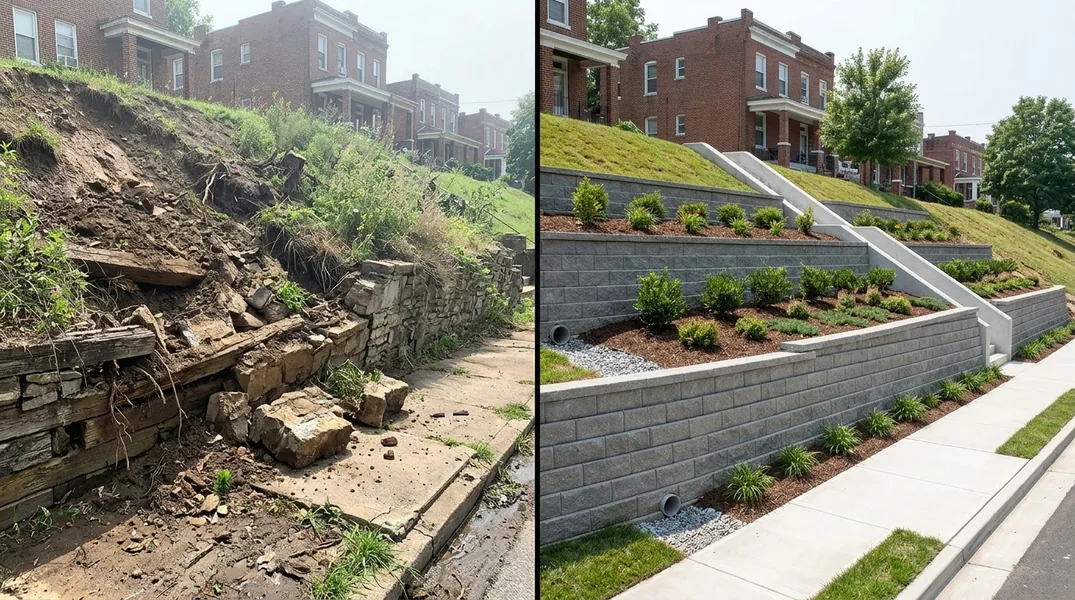
Block retaining walls and segmental retaining walls are closely related and together represent the most popular choice for residential projects in the region. Segmental systems use interlocking units that stack without mortar, allowing the wall to flex slightly with soil movement instead of cracking. That flexibility is a real advantage in Baltimore's expansive clay, where a rigid wall may develop fissures over time. Block walls, whether mortar-set or dry-stacked, offer a wide range of colors and textures that can complement brick rowhouses, stone facades, and modern siding alike.
These systems also tend to be more budget-friendly than poured concrete and faster to install, which makes them attractive for terraced gardens, driveway edges, and mid-height walls. The key is proper base preparation and backfill drainage, because even a flexible wall will fail if water cannot escape. If you are comparing options and want to understand how material choice affects your project, our pricing page outlines the general ranges. A segmental or block wall is often the sweet spot between durability, appearance, and cost for Towson and Baltimore homeowners dealing with moderate slopes.
Boulder Retaining Walls: Natural Character for Rocky, Steep Lots
Boulder retaining walls bring a rugged, natural look that suits wooded lots and properties where the landscape already includes stone. Large boulders are heavy enough to resist soil pressure through sheer mass, and their irregular shapes can be arranged to follow a slope organically. On steep lots with rocky ground, boulders can sometimes be set with less excavation than a formal block wall, and they blend into the surroundings rather than calling attention to themselves. For homeowners who want a wall that looks like it belongs on the land, boulders are hard to beat.
That said, boulder walls require careful sizing and placement. Smaller stones may not hold, and poor stacking can create voids where water and soil migrate. They are also less predictable in cost because stone availability and hauling distances vary. In rocky areas around Ellicott City, boulders can be a practical and attractive solution, but they should be installed by someone who understands how to seat each stone for stability. If a boulder wall on your property is leaning or settling, Retaining Wall Repair may be able to reset or reinforce it before it becomes a safety concern.
Matching the Material to Your Lot: Clay, Rock, and Steep Terrain
There is no single best material for every property. On heavy clay, flexibility and drainage usually matter more than raw mass, which often points toward segmental or block systems with engineered backfill. On rocky ground where excavation is difficult, boulders can reduce the amount of digging required. On tall walls or steep lots where failure would be costly, poured concrete provides the strength and engineering confidence that lighter materials cannot match. The right answer depends on height, soil, water flow, and what you want the finished wall to look like.
This is why an on-site evaluation is so valuable. A contractor can probe the soil, assess the slope, and identify where water collects during storms. That information shapes the recommendation far more than a photo or a square-foot measurement ever could. Whether your project calls for new Retaining Wall Installation or a full Retaining Wall Replacement after an older wall has failed, the material decision should follow the site conditions, not precede them.
Retaining Wall Installation Near Me: When to Call a Professional
Small garden walls under about three feet can sometimes be a DIY project, but once a wall is holding back a significant load, protecting a structure, or sitting on a steep slope, the margin for error shrinks quickly. Baltimore's clay and seasonal weather put extra stress on retaining structures, and a wall that was underbuilt or poorly drained can fail suddenly after a heavy rain. Warning signs include bulging, leaning, cracking, soil washing out from behind the wall, and water pooling at the base.
If you are seeing any of those signs, or if you are planning a new wall and want it done right the first time, it is worth talking to a local specialist. Baltimore Retaining Wall serves homeowners across the area and can evaluate your soil, slope, and drainage before recommending a material. Call (443) 806-9687 or request a free estimate to get started. A short conversation now can save you from a much larger repair later, and it gives you a clear picture of which material makes sense for your specific lot.
Looking for a professional retaining wall contractor in Baltimore? Baltimore Retaining Wall responds fast for all your retaining wall needs.
Get a Free QuoteOur services: Retaining Wall Installation · Retaining Wall Repair · Retaining Wall Replacement