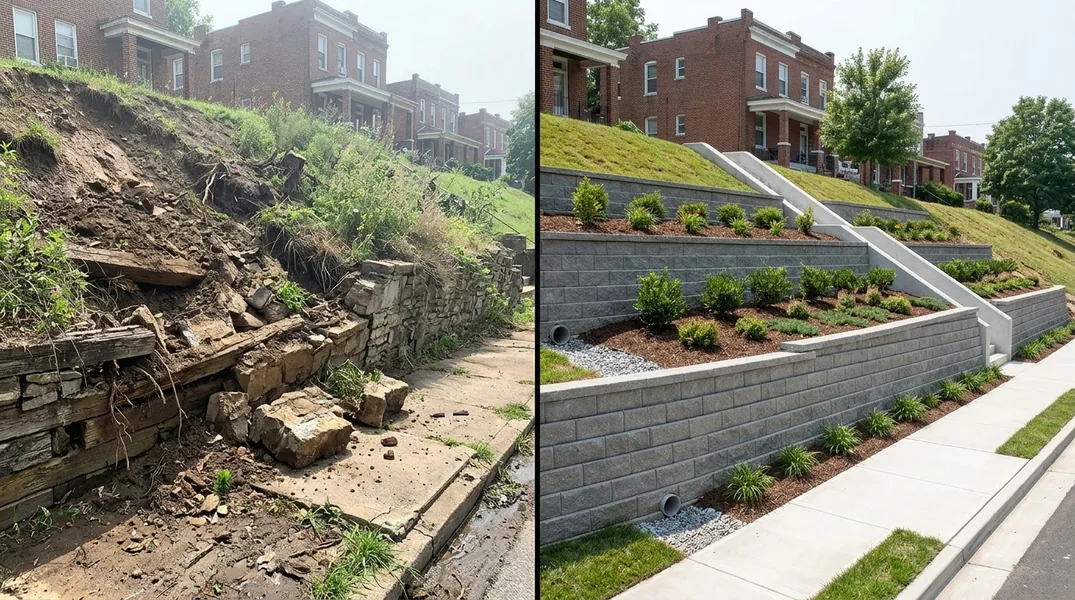
Why Baltimore's Summer Storms Are Hard on Retaining Walls
Summer in Baltimore means heat, humidity, and sudden thunderstorms that can dump an inch of rain in under an hour. Those intense downpours are the number one seasonal threat to retaining walls, and most homeowners never see the damage coming until a wall is already leaning or cracking. The problem is not the rain itself. It is what happens to the water after it hits the ground behind your wall.
When soil becomes saturated faster than it can drain, water builds up behind the wall and pushes outward with enormous force. This is called hydrostatic pressure, and it is the leading cause of retaining wall failure in the mid-Atlantic region. A wall that looked perfectly solid in May can develop bulging, settlement, or joint separation by August if its drainage system is undersized or clogged. Understanding this cycle is the first step toward protecting your investment, and our team at Baltimore Retaining Wall sees the results of poor drainage on jobs across the city every single season.
How Hydrostatic Pressure Quietly Destroys a Wall
Hydrostatic pressure builds when water cannot escape the soil behind a retaining wall. Every cubic foot of saturated soil weighs significantly more than dry soil, and the water itself exerts lateral force against the back of the wall. Most residential walls are engineered to handle the weight of soil and normal groundwater, but they are not engineered to act as dams. When water accumulates, the pressure can double or triple the load the wall was designed for, and something has to give.
The damage usually follows a predictable pattern. First, water finds weak points in the wall and seeps through, leaving efflorescence, dark stains, or muddy streaks on the face. Next, the soil behind the wall softens and loses bearing capacity, causing the wall to settle or tilt. Eventually, mortar joints crack, blocks shift, and in severe cases the wall can fail catastrophically. If you notice any of these warning signs, it is worth requesting a free estimate for an inspection before the next storm season arrives.
The Retaining Wall French Drain: Your Wall's Best Defense
The most effective solution for managing water behind a retaining wall is a retaining wall french drain. This system typically consists of a perforated pipe wrapped in filter fabric, set in a bed of washed gravel at the base of the wall, and connected to a discharge point away from the structure. When installed correctly, it intercepts groundwater before it can build pressure and carries it safely away from the wall and foundation.
A proper french drain also includes drainage gravel backfill and a filter fabric barrier to prevent fine soil particles from clogging the pipe over time. Many failing walls in Towson and Columbia were built without adequate drainage or with weep holes alone, which are simply not enough during a heavy summer storm. If your wall is showing signs of water damage, our Retaining Wall Repair services can retrofit a proper drainage system and restore structural integrity before small problems become expensive ones.
Signs Your Wall Needs Drainage Help Now
Homeowners often ask how to tell whether a wall has a drainage problem or just normal weathering. The clearest indicators are water stains or efflorescence on the wall face, soggy ground at the base of the wall after rain, and visible tilting or bulging. You may also notice that the soil behind the wall has settled, creating a depression that collects water and makes the problem worse with each storm.
Cracks that widen over time are another red flag. Hairline cracks are common in Concrete Retaining Walls, but if a crack is wider than a quarter inch or is accompanied by horizontal displacement, the wall is likely under hydrostatic pressure. In these cases, patching the crack alone will not solve the underlying issue. A proper assessment of the drainage system is essential, and sometimes a full Retaining Wall Replacement is the most cost-effective long-term solution when the original wall was poorly drained.
Retaining Wall Drainage Near Me: When to Call a Professional
If you are searching for retaining wall drainage help near me, you are probably already seeing the warning signs and wondering whether the problem is serious enough to warrant a professional visit. The honest answer is that drainage problems rarely fix themselves, and they almost always get worse during storm season. A small french drain retrofit done early is far less expensive than rebuilding a collapsed wall later.
Our team serves homeowners throughout the region, including Ellicott City, and we can evaluate your wall's drainage, identify the source of the pressure, and recommend the right fix. Whether you need a new drainage system, targeted repairs, or a complete Retaining Wall Installation with proper drainage built in from day one, we will give you a clear assessment and honest pricing before any work begins. Call (443) 806-9687 to schedule your evaluation and protect your wall before the next round of summer storms.
Looking for a professional retaining wall contractor in Baltimore? Baltimore Retaining Wall responds fast for all your retaining wall needs.
Get a Free QuoteOur services: Retaining Wall Installation · Retaining Wall Repair · Retaining Wall Replacement