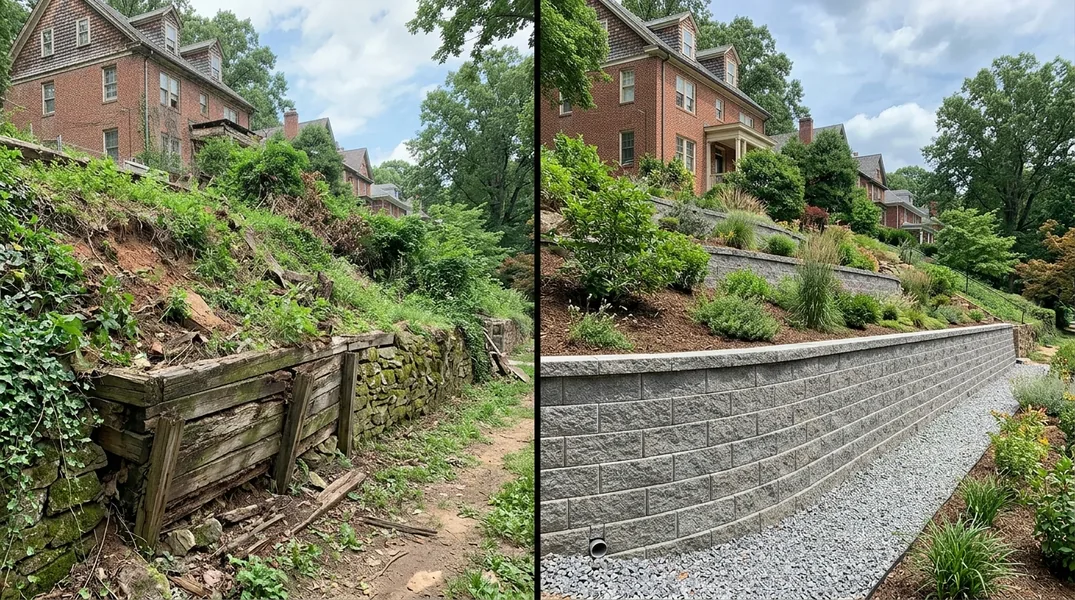
Why Leaning Retaining Walls Are a Serious Warning Sign
A retaining wall that leans is not just an eyesore. It is a structural warning that the wall is no longer doing its job safely. In Baltimore, where heavy clay soils and freeze-thaw cycles put constant pressure on walls, leaning is one of the most common problems homeowners report. The lean usually means the wall has begun to rotate or slide forward because the soil behind it is pushing harder than the wall can resist.
Ignoring a lean is risky. A wall that moves even a few inches can suddenly fail after a heavy rain, sending soil and debris into your yard, driveway, or neighbor's property. Before you decide between repair and replacement, it helps to understand what caused the movement. Poor drainage, inadequate footing depth, root intrusion, and simply age are the usual suspects. A professional assessment will tell you whether the wall is still stable enough to save or whether it has crossed the line into unsafe territory.
Signs You May Only Need Leaning Retaining Wall Repair
Not every leaning wall requires a full rebuild. If the movement is minor and caught early, Retaining Wall Repair can often stabilize the structure at a fraction of the cost of replacement. Small cracks, slight tilting, and localized bulging are candidates for repair when the wall's foundation and drainage system are still fundamentally sound. In many cases, the fix involves improving drainage behind the wall, replacing failed backfill, and reinforcing the affected section.
Crack repair is another common repair scenario. Hairline cracks in concrete or mortar joints are usually cosmetic, but wider cracks that let water in can accelerate deterioration. A qualified contractor will evaluate whether the cracks are superficial or signs of deeper movement. If the wall is less than a few years old and the lean is small, repair is almost always worth exploring first. The key is getting an honest evaluation rather than a sales pitch for a new wall you do not need.
When Retaining Wall Replacement Is the Right Call
Some walls are simply beyond saving. If the wall has rotated significantly, shows multiple wide cracks, or has settled unevenly along its length, repair may only be a temporary patch on a failing structure. Walls built with inadequate footings, missing drainage, or poor compaction often fail again even after repairs. In those cases, Retaining Wall Replacement is the safer and more cost-effective long-term choice.
Replacement also makes sense when you want to upgrade materials or increase the wall's height and load capacity. Modern Concrete Retaining Walls are engineered to handle the soil pressures and weather conditions common in the Towson and Columbia areas, and they come with proper drainage built in from day one. A new wall designed correctly will outperform a patched-up older wall for decades.
How a Professional Evaluation Decides Between Repair and Replace
The decision should never be based on guesswork. A professional evaluation looks at the wall's height, the soil type behind it, drainage conditions, and the extent of movement. Contractors use levels and visual inspection to measure how far the wall has tilted and whether the footing has shifted. They also check for water pooling, clogged weep holes, and signs of soil erosion that indicate drainage failure.
In the Ellicott City area, where slopes and stormwater are common concerns, this evaluation is especially important. A wall that looks fine on the surface can be hiding saturated soil that is ready to push it over. A thorough inspection gives you a clear recommendation: repair the wall if it is structurally sound, or replace it if safety or long-term performance is in question. Either way, you get a straight answer and a plan.
Retaining Wall Repair Near Me: Finding Trusted Help in Baltimore
When you search for retaining wall repair near me, you want a local contractor who understands the specific soil and weather challenges in the Baltimore region. National franchises may not have the local experience to diagnose why your wall is leaning. A local specialist can spot the difference between a wall that needs drainage correction and one that needs a full rebuild.
Baltimore Retaining Wall serves homeowners throughout the area with honest assessments and quality workmanship. Whether you need a small crack repair or a complete replacement, the team will walk you through your options and help you make an informed decision. Call (443) 806-9687 to schedule a free estimate and find out exactly what your wall needs.
What to Budget for Repair or Replacement
Cost is a major factor in the repair-versus-replace decision, and the range can be wide. Minor crack repair and drainage improvements are typically the least expensive option, while full replacement costs more upfront but may save money over time by preventing repeated fixes. Factors that affect pricing include wall height, length, material choice, site access, and the condition of the existing footing.
Before committing, ask for a written estimate that breaks down labor, materials, and any drainage work. A reputable contractor will explain why a repair is sufficient or why replacement is recommended, and will not pressure you into unnecessary work. With a clear estimate in hand, you can compare the short-term cost of repair against the long-term value of a new, properly engineered wall and choose the option that fits your budget and your property's needs.
Looking for a professional retaining wall contractor in Baltimore? Baltimore Retaining Wall responds fast for all your retaining wall needs.
Get a Free QuoteOur services: Retaining Wall Installation · Retaining Wall Repair · Retaining Wall Replacement