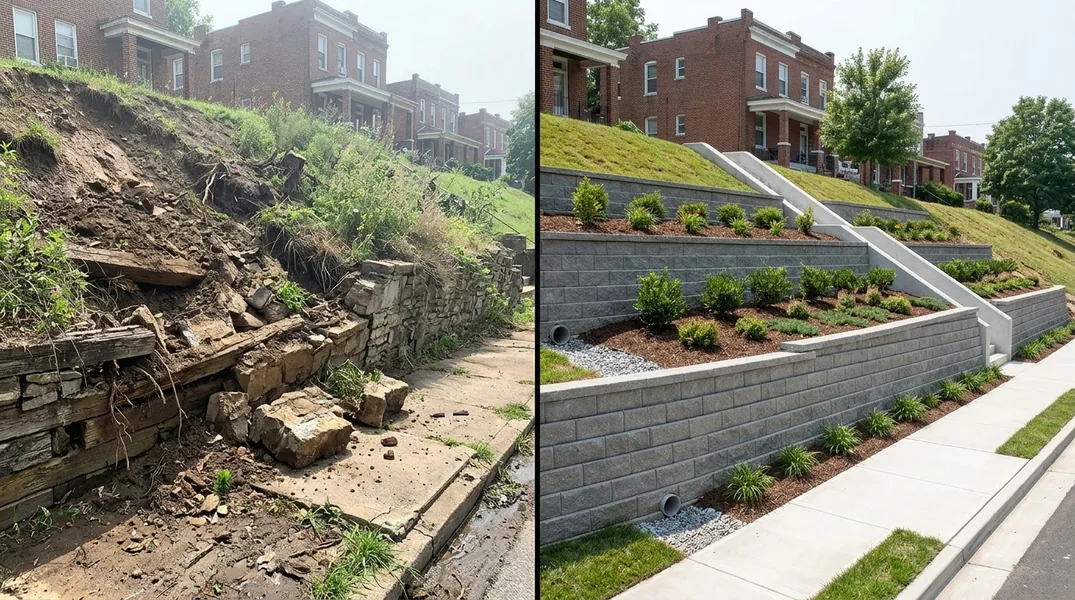
Why Baltimore's Terrain Is Tough on Retaining Walls
If you live in Baltimore, you already know the city is not flat. From the steep slopes of Roland Park and Mount Washington to the stream valleys that wind through Patapsco and Herring Run, our landscape puts constant pressure on the walls that hold back soil. That pressure is the number one reason retaining walls fail here, and it is why homeowners need to understand what is happening underground before a small problem becomes a dangerous one.
The soil in this region is a mix of clay, silt, and weathered rock. Clay expands when it gets wet and shrinks when it dries, and Baltimore's freeze-thaw cycles make that movement even worse. Water from heavy summer storms and snowmelt saturates the ground behind a wall, adding weight and pushing outward. If the wall was not designed with proper drainage, that water has nowhere to go, and the wall takes the full force. Over time, even a well-built wall can begin to lean, bow, or crack. Understanding these forces is the first step toward protecting your property.
The Most Common Reasons Retaining Walls Fail
Most failing walls in the Baltimore area share a few root causes. The first is poor drainage. A retaining wall is essentially a dam for soil, and water must be directed away from it. When weep holes clog or a French drain is missing, hydrostatic pressure builds up behind the wall and pushes it forward. The second cause is inadequate footing. Walls built on soft clay or without a proper base can settle unevenly, which leads to cracking and leaning. The third is a lack of geogrid reinforcement. Taller walls need layers of grid to tie the wall into the soil behind it, and skipping this step is a recipe for a bowing retaining wall.
Another common issue is using the wrong material for the job. A small garden wall made of stacked blocks can look great, but it cannot hold back a steep hillside. When homeowners ask us about a bowing retaining wall fix, we often find that the original wall was simply undersized for the load. In stream valleys, constant moisture and occasional flooding add another layer of stress. If you are seeing the signs of a failing retaining wall, it is worth having a professional take a look before the problem gets worse. You can reach our team at (443) 806-9687 for a free estimate.
Warning Signs: How to Spot a Leaning or Failing Retaining Wall
Homeowners often miss the early warning signs because retaining walls fail slowly. One of the first things to check is whether the wall is still straight. A leaning retaining wall may start with just a slight tilt at the top, but that tilt will grow. Look for horizontal cracks, stair-step cracks in block walls, or bulging sections. Check the soil at the base of the wall for signs of erosion or pooling water. If you see water stains, efflorescence (a white powdery deposit), or muddy patches, that is a sign that water is moving through the wall instead of around it.
Other red flags include separation between the wall and the soil behind it, sinking sections, and loose or missing capstones. In severe cases, you may notice the wall pushing into a sidewalk or driveway. A failing retaining wall can also cause settlement cracks in nearby patios or foundations. If you spot any of these issues, do not wait. A small crack can often be addressed with Retaining Wall Repair, but a wall that is significantly leaning or bowing may need Retaining Wall Replacement. Catching the problem early usually saves money and prevents safety hazards.
Retaining Wall Repair Near Me: When to Call a Professional
If you are searching for retaining wall repair near me in Baltimore, you are probably wondering whether the problem is serious enough to call someone. The honest answer is that any wall showing movement, cracks wider than a quarter inch, or drainage issues should be evaluated by a professional. DIY fixes like patching cracks or adding a coat of sealant do not address the underlying pressure and water problems. In fact, they can hide the symptoms while the wall continues to fail. A professional assessment will identify whether the wall needs reinforcement, drainage improvements, or a full replacement.
Our team serves homeowners throughout the area, including Towson, Columbia, and Ellicott City. We start by evaluating the wall's condition, the soil, and the drainage. Then we recommend the most cost-effective solution, whether that is repair, reinforcement, or replacement with Concrete Retaining Walls built to handle Baltimore's challenging terrain. If you are unsure about the condition of your wall, a free estimate is the easiest way to get answers.
How to Prevent Retaining Wall Failure
Prevention starts with proper design and installation. A wall that is engineered for the slope, soil type, and water load will last for decades. If you are planning a new wall, make sure the contractor includes a proper drainage system, compacted base, and reinforcement as needed. For existing walls, regular maintenance goes a long way. Keep weep holes clear, direct downspouts and surface water away from the wall, and avoid planting large trees too close to the structure. Inspect your wall after heavy storms and at the start of each season.
If you are considering a new wall or need help with an existing one, our team at Baltimore Retaining Wall is here to help. We specialize in Retaining Wall Installation and repair throughout the Baltimore area. Call us at (443) 806-9687 or visit our website to learn more about our services and pricing. A well-built wall protects your property and adds value, and the right professional can make sure it stands up to Baltimore's hills and stream valleys for years to come.
Looking for a professional retaining wall contractor in Baltimore? Baltimore Retaining Wall responds fast for all your retaining wall needs.
Get a Free QuoteOur services: Retaining Wall Installation · Retaining Wall Repair · Retaining Wall Replacement